
Chatling and ChatNorris share a basic promise: create an AI agent, train it on company content, and publish it on a website without a complex technical project. Both use credit-based plans and can extend the experience into messaging channels.
The differences appear in day-to-day operations. Chatling offers a broad model catalog, visual tools, and more published integrations. ChatNorris puts more emphasis on a bilingual experience, official WhatsApp onboarding, and one knowledge base across web and Meta channels.
Plans change frequently. Check the official Chatling and ChatNorris pages before deciding.
Quick comparison
| Criterion | Chatling | ChatNorris |
|---|---|---|
| Focus | Web agent with visual building and model variety | Multichannel agent focused on web and messaging |
| Training | URLs, documents, and other sources | Websites, documents, FAQs, text, and integrations |
| Pricing model | Credits with model-dependent consumption | Credits with model-dependent consumption |
| Channels | Web and messaging channels by plan | Web, Telegram, and Meta channels by plan |
| Available on applicable plans | From Standard through Embedded Signup | |
| Integrations | Broader catalog | WooCommerce and Zendesk as primary integrations |
| Product language | Primarily English | English and Spanish |
Training and answer quality
Both platforms use knowledge retrieval to answer with company information. Final quality depends less on the number of sources than on their accuracy, the system instructions, and the testing performed before launch.
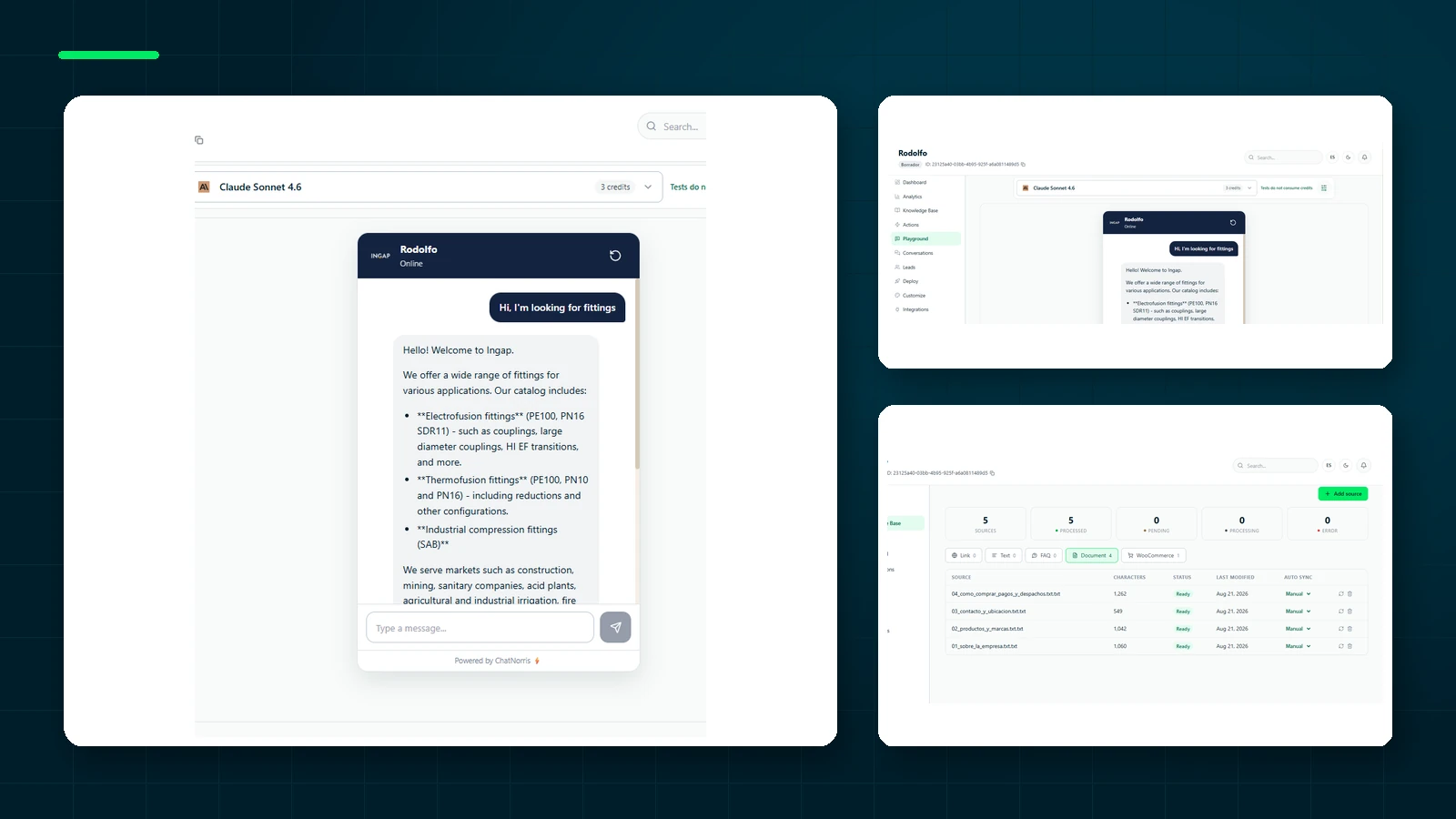
Chatling is attractive to teams that want to experiment with many models and build visual flows. ChatNorris focuses on an agent that can use website content, documents, FAQs, WooCommerce, or Zendesk, with a playground that does not consume credits.
Channels and WhatsApp onboarding
Chatling is no longer just a widget; it offers messaging channels on its plans. The meaningful difference is not whether a channel logo appears in a table, but how each connection is established and operated.
ChatNorris is a Meta Tech Provider and uses Embedded Signup so each organization can connect its WhatsApp account and number through an official flow, without copying credentials from a developer dashboard. WhatsApp is available on Standard; Instagram and Messenger are on Premium.
If Instagram is the dominant channel and the required plan does not fit the budget, Chatling or a marketing tool such as ManyChat may be a better match. If WhatsApp and the website must share one agent and one knowledge base, ChatNorris has a clear operational advantage.
Credits and predictability
Both products use credits, with consumption varying by selected model. This makes it possible to trade cost for capability, but estimates should use the model you will actually deploy. A plan with more credits does not always produce more answers if each interaction consumes more.
ChatNorris includes a defined allowance in each plan, and playground testing is not deducted. AI is not unlimited: once the allowance is reached, you wait for the next period or change plans. The benefit is that spend does not automatically increase with every resolution.
Integrations and language
Chatling publishes a broader integration catalog, including sales and productivity tools. If HubSpot, Zoho, or Cal.com is essential, that breadth may decide the purchase.
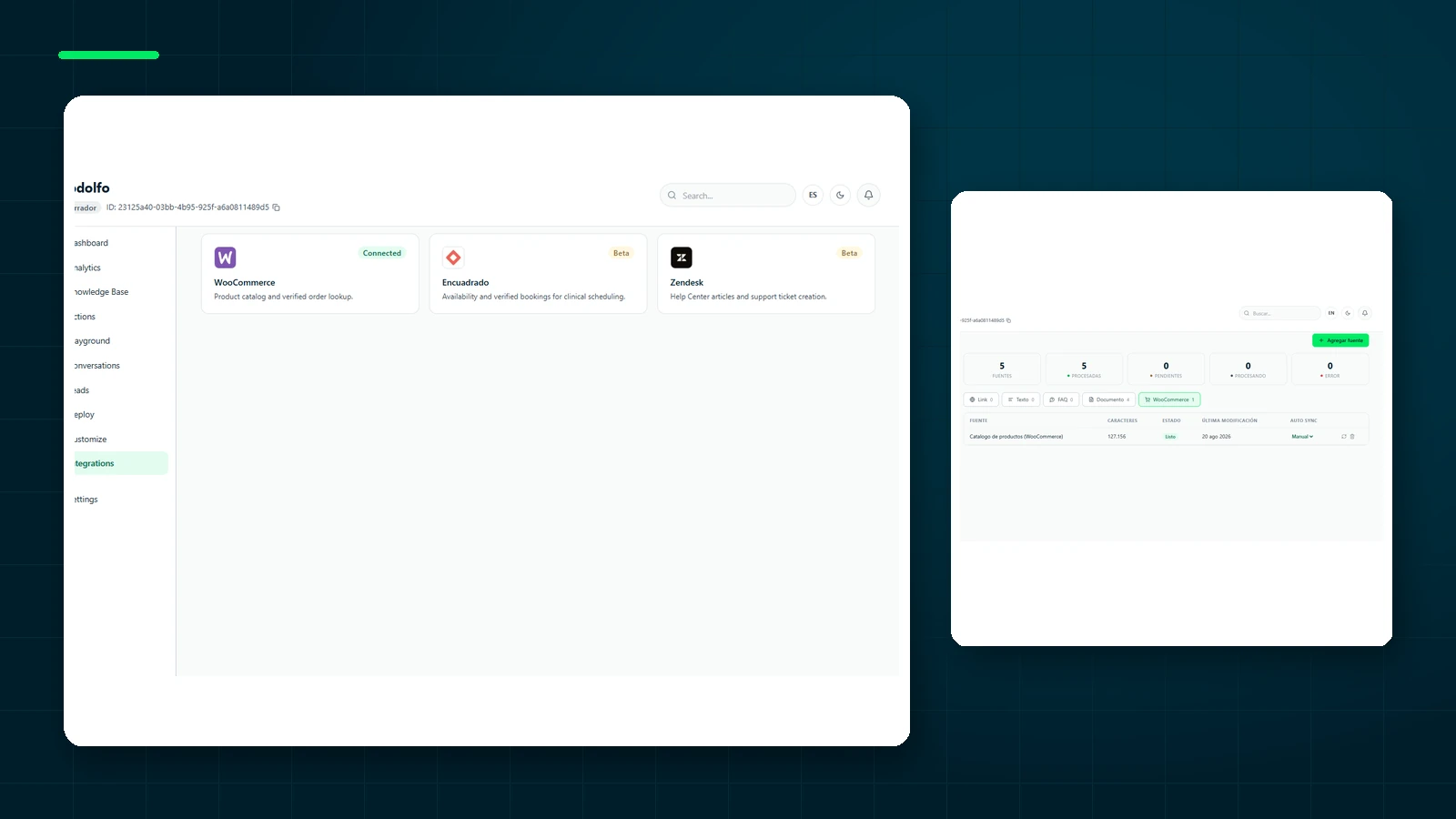
ChatNorris prioritizes WooCommerce and Zendesk in a per-agent integrations hub, with one connection reusable by knowledge and actions. Its dashboard, content, and support are also available in English and Spanish—a practical difference for bilingual teams.
- Official WhatsApp onboarding and shared knowledge across channels
- Complete English and Spanish experience
- WooCommerce and Zendesk integrated into the agent workflow
- Smaller integration catalog
- Fewer models and visual tools than Chatling
- Instagram and Messenger require Premium
Create an agent for free, load your sources, and evaluate its answers before connecting a channel.
Try ChatNorrisWhat changes in day-to-day operations
The difference between two agents rarely appears in the first answer. It becomes visible when content changes, a channel disconnects, a user asks for a person, or the team must explain why AI responded in a particular way. An evaluation should therefore include administrative work, not only a demo conversation.
Chatling's model variety and visual building tools create more room for experimentation. That flexibility helps teams designing different experiences or connecting sales tools. It also creates more decisions around models, consumption, and configuration.
ChatNorris narrows some of that surface and directs the workflow toward a shared knowledge base, per-agent connections, and bilingual operations. The benefit appears when one team manages web, WhatsApp, and support without translating interfaces or duplicating credentials. The tradeoff is a smaller integration catalog and fewer options for teams building complex visual flows.
Security, credentials, and connection ownership
Channels and integrations access company data. Ask where credentials are stored, who can rotate them, and whether one connection can serve multiple capabilities. Pasting the same key into several configurations increases inconsistency and makes a provider harder to disconnect safely.
Ownership matters for WhatsApp too. Each organization should connect its own account and retain control of the number. ChatNorris's Embedded Signup flow is designed for that model. When evaluating Chatling, review its current process, Meta requirements, and the procedure for migrating or disconnecting the channel.
On both platforms, limit administrative access to people who actually manage agents and sources. A small instruction change or an incorrect source can affect answers across every channel. Easy configuration does not eliminate the need for governance.
A five-step testing method
- Select representative sources. Include stable content and information that changes frequently.
- Ask real questions. Use historical conversations, typos, and requests with no answer in the source material.
- Test escalation. Ask for a person, provide partial information, and inspect the context the operator receives.
- Update a source. Check the synchronization process and when the new information becomes available.
- Calculate consumption. Run the same set with the model you would deploy, not the cheapest model selected only for testing.
Record results and score accuracy, usefulness, tone, traceability, and maintenance. When an answer is wrong, determine whether the cause is the source, retrieval, instructions, or model. That distinction reveals how much control you will have after launch.
Migration and coexistence
You can test ChatNorris without removing Chatling. Use a test domain or the playground, load a representative source set, and leave production channels unchanged. Once behavior is stable, migrate the widget or a lower-risk channel first.
Do not keep two public agents producing different answers for long. Each develops its own history, configuration, and update schedule. Overlap is useful for evaluation, but it is rarely a desirable long-term architecture.
Verdict
Choose Chatling if the widget is your main channel, you need a broad model catalog, or you depend on integrations ChatNorris does not yet offer.
Choose ChatNorris if WhatsApp must share knowledge with the website, your team works in English and Spanish, or official Meta onboarding matters.
Neither platform wins every category. The best test is to load the same sources, ask real customer questions, and compare answer quality, expected cost, and the escalation workflow.
Frequently asked questions
Which one gives better answers?
There is no universal answer. It depends on sources, instructions, and model selection. Compare both with the same questions and evaluate accuracy rather than style alone.
Can I change models after launch?
Both platforms support model selection, but a change can alter quality and consumption. Run the full test set again before applying it to all traffic.
Which platform is better for WhatsApp?
ChatNorris has a more explicit proposition around Embedded Signup and knowledge shared with the website. The final decision should include volume, plan, human operations, and any campaign requirements.