
Intercom Fin and ChatNorris can answer questions with AI, use company content, and transfer conversations to a person. That is where much of the similarity ends.
Fin is part of a broad customer-service suite. ChatNorris is more focused: it creates agents for websites and messaging channels, with an inbox for supervising and taking over conversations. The choice depends less on the language model than on the operation you need around it.
Quick comparison
| Intercom + Fin | ChatNorris | |
|---|---|---|
| Core product | Support and messaging suite | AI-agent platform |
| Knowledge | Help center and connected sources | Website, documents, FAQs, Zendesk, and other sources |
| AI pricing | Resolution-related pricing plus the applicable plan | Included credits based on plan and model |
| Channels | Product messenger and additional channels | Web, Telegram, and Meta channels by plan |
| Human operation | Advanced routing, SLAs, roles, and reporting | Simpler inbox, assignment, and handoff |
| Best fit | Structured support organizations | Small and midsize teams focused on self-service |
Prices and packaging change frequently. Check the official Intercom and ChatNorris pages with your expected volume before deciding.
Where Intercom Fin is stronger
A complete support operation
Intercom is not just a chatbot. It combines conversation management, automation, reporting, help content, and tools for teams with established processes. If your inbox and help center already live there, Fin uses infrastructure you do not need to rebuild.
Advanced metrics and routing
Teams working with service levels, multiple inboxes, and detailed taxonomies will find more depth in Intercom. ChatNorris does not try to replace a full contact center.
Messaging inside a SaaS product
Intercom was built to engage users within applications. If support, onboarding, and proactive messaging happen inside the product, that heritage matters.
Where ChatNorris is a better fit
An agent without adopting a full suite
ChatNorris lets you train an agent on company content, publish it on a website, and connect messaging channels without buying a broader customer-success stack. Standard includes WhatsApp, while Premium adds Instagram and Messenger.
A budget bounded by credits
Plans include an AI-credit allowance, and each model has defined consumption. This makes it easier to set a monthly ceiling. Intercom uses a resolution-oriented model alongside the contracted suite components; estimate seats, channels, and resolution volume together.
WhatsApp with the same knowledge as the website
ChatNorris uses the same agent configuration and knowledge base across both touchpoints. WhatsApp connects through Embedded Signup under its Meta Tech Provider flow.
- A more focused product with bounded usage
- The same agent on web and WhatsApp
- English and Spanish product experience and support
- Less depth in routing, SLAs, and reporting
- Does not include Intercom's broader customer-success tools
Train ChatNorris on your content and evaluate its answers for free before connecting customer channels.
Get started freeThe pricing model changes the incentives
Resolution-based pricing connects price to an outcome: the company pays when AI resolves a case without human intervention. It is an intuitive unit and can work well when the value of each resolved ticket is understood. It also means spending grows as automation succeeds.
Credits behave differently. Consumption depends on answers and the selected model rather than whether the platform labels a conversation as resolved. Plans can create a spending ceiling, but teams must understand how many turns each case requires. A short exchange and a twenty-message conversation do not cost the same amount of credits.
Neither model is inherently fairer. Compare them using monthly volume, expected resolution rate, and conversation length. For Intercom, include the applicable plan, seats, channels, and Fin component. For ChatNorris, project model-specific credits and decide what happens at the limit. Always use current documentation and pricing because packaging changes.
Knowledge quality and maintenance
Fin is especially compelling when a company already maintains a well-governed help center in Intercom. Articles have owners, analytics, and an update cycle. The agent benefits from that existing investment.
ChatNorris builds a knowledge base from websites, documents, FAQs, and connections such as Zendesk. That is a direct path for companies without an existing suite, but quality still depends on the source material. Importing outdated content only automates outdated answers.
In either case, decide who reviews articles, how gaps are identified, and which conversations feed improvements. An agent is not a project that ends at launch. Real customer questions reveal ambiguous terms, conflicting policies, and information the website never explained.
Human handoff and the team experience
Intercom provides more depth for operations with queues, priorities, roles, SLAs, and multiple teams. The agent sits inside a structure where each conversation can be routed and measured in detail. That complexity creates value when specialists and volume justify it.
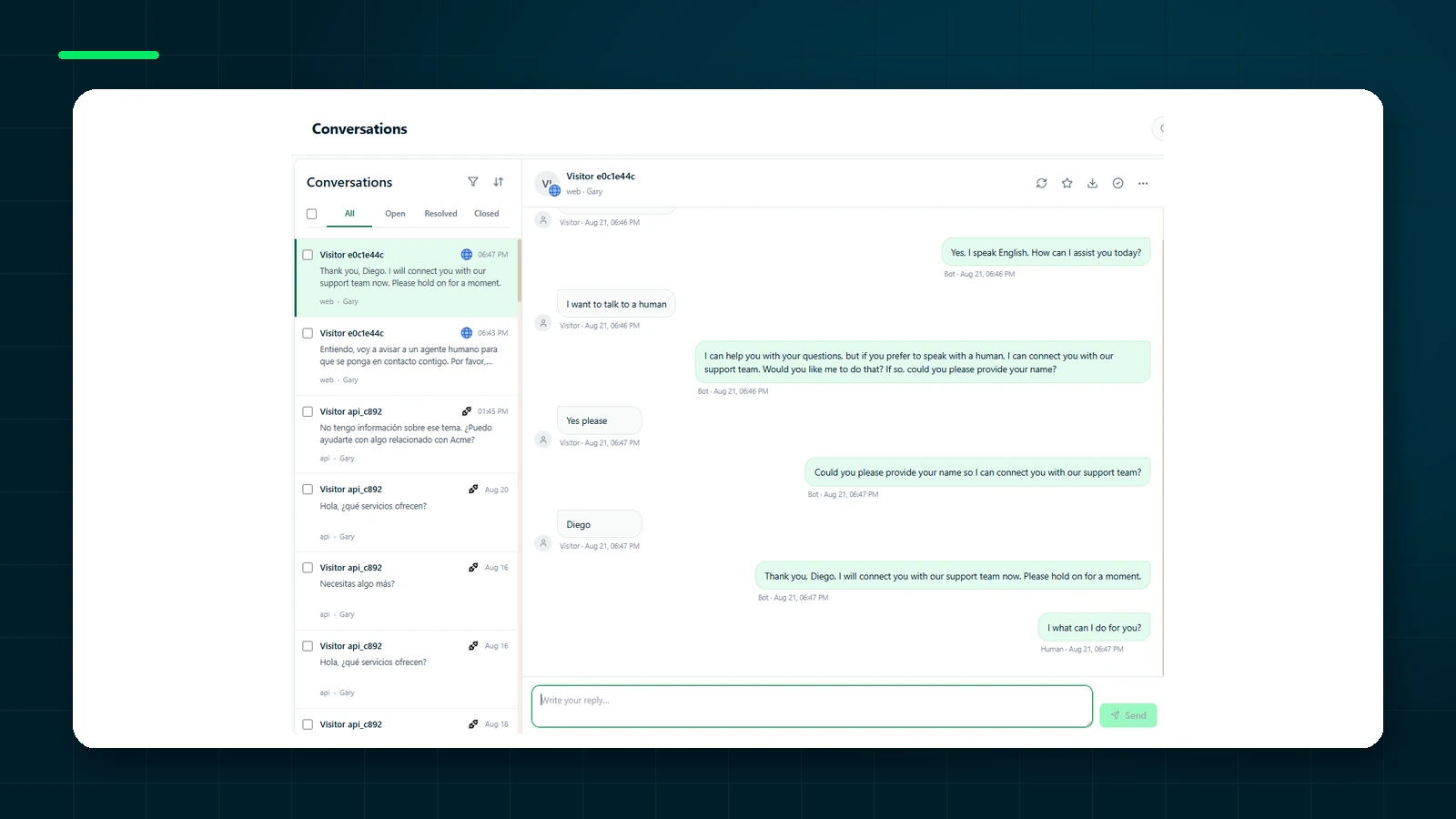
ChatNorris offers a simpler flow: AI handles the initial conversation, can start handoff, and a team member takes over. For a small business, less configuration can accelerate deployment. For a contact center with several support levels, it may not be enough.
Evaluate the difficult case, not only the automated answer. Simulate an urgent request, an after-hours question, a user changing topics, and a conversation requiring private information. Observe what the customer sees, what context reaches the operator, and how the system prevents AI from continuing during human intervention.
When a full suite is justified
Intercom makes sense when several layers are used together: in-product messaging, help center, automation, onboarding campaigns, reporting, and human support. Buying the whole platform only to add Fin may be excessive, but rejecting it on price alone is also a mistake if it replaces several existing tools.
ChatNorris fits a more defined scope: answer with company knowledge across web and messaging, capture leads, and escalate cases. Its smaller surface helps teams that do not want to operate a customer-success platform. It does not attempt to cover product tours, in-app campaigns, or Intercom's routing depth.
Map the complete process from initial question to resolution and reporting. If most blocks already live in Intercom, Fin is a natural extension. If you need only the agent and two primary channels, a focused platform can reduce cost and complexity.
Which one should you choose?
Choose Intercom Fin if you already work in Intercom, run a support team with complex processes, or need in-product messaging, advanced routing, and analytics.
Choose ChatNorris if you want an agent trained on your content for web and WhatsApp, prefer credit-bounded usage, and do not need a complete support suite.
They are not exact substitutes. Intercom offers an end-to-end support operation; ChatNorris concentrates the investment on the agent and the channels where it talks.
Frequently asked questions
Can ChatNorris replace Intercom completely?
Not in every case. It can cover an agent, widget, messaging, and handoff for a straightforward operation. It does not replace Intercom's entire support suite, in-product messaging, routing, and advanced analytics.
Which has more predictable cost?
It depends on what you can predict. Credits bound consumption, while resolutions connect cost to outcome. Model both using your volume, conversation length, seats, and channels.
Does it make sense to use both?
It can if they have clearly separated roles, but two agents and knowledge bases increase maintenance. Assign one owner to each channel and avoid letting both answer the same conversation.