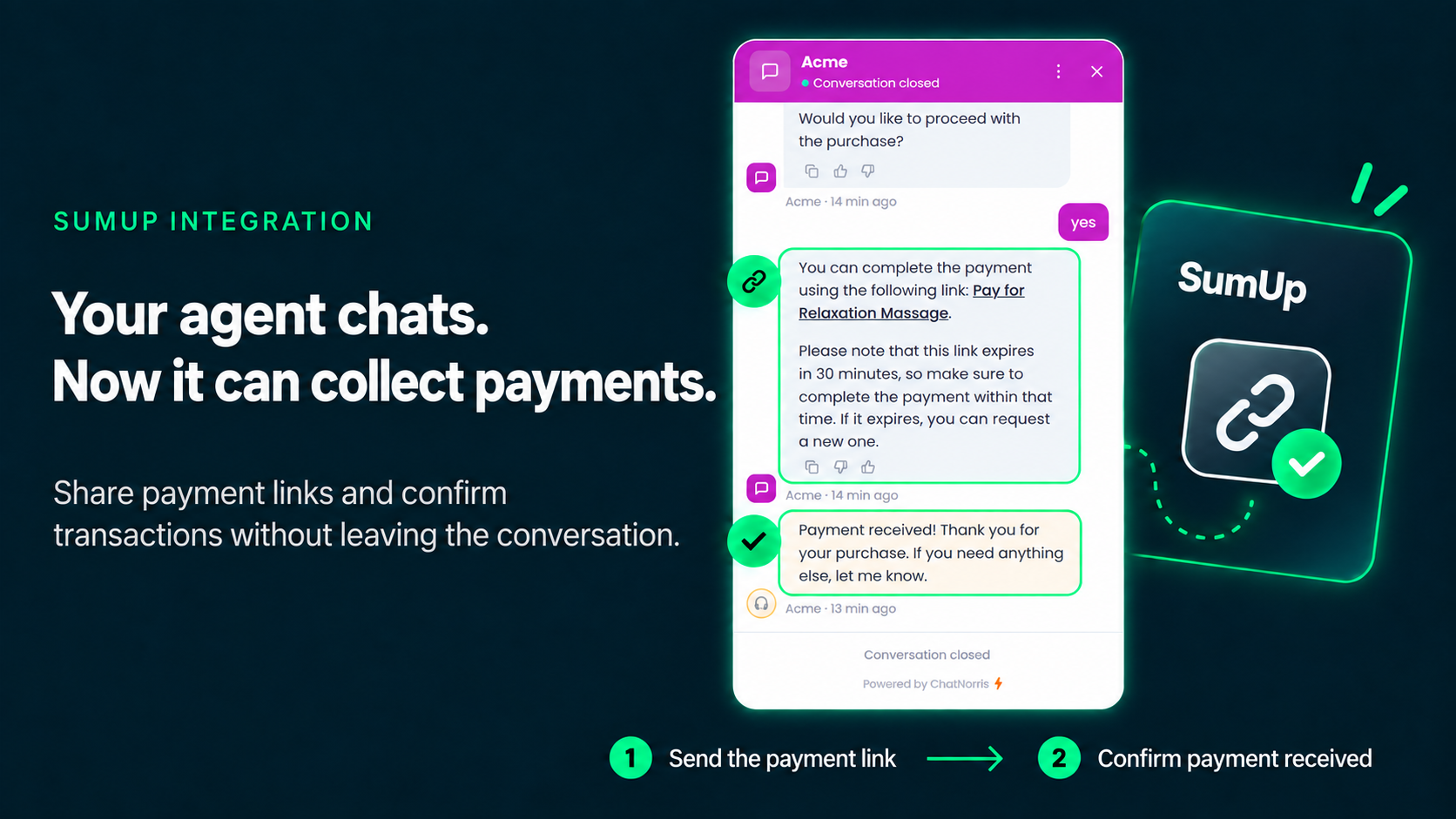
Until now, your ChatNorris agent could answer questions, check an order's status in WooCommerce or Odoo, or book an appointment. One step was missing: charging for it. With the new Payment action, integrated with SumUp, your agent can generate a real checkout link inside the same conversation — no need for the visitor to leave the chat, message you on another channel, or wait for someone on your team to send a link by hand.
One clarification up front, since it's what we get asked about most: the payment is handled by SumUp from start to finish. ChatNorris takes no part in the actual charge — it doesn't process the card, it never sees that data, and the money goes straight into your business's SumUp account, never to us.
From "checking the order" to "charging for it"
We've already covered how your agent can look up an order's status in WooCommerce or answer "where's my order?" without anyone on your team having to go find it. That solves half the problem — the other half is the sale that never closes because the customer asks for the price, says "yes, I want it," and the conversation stalls right there: someone has to generate a separate payment link, send it through another channel, and wait.
With the Payment action, that step disappears. You configure a catalog of products or services (name, price, currency) from the dashboard, and once the visitor confirms they want to buy, the agent generates the checkout link right there — in the web widget, on WhatsApp, on Instagram, or on whichever channel the conversation is happening.
How it works, step by step
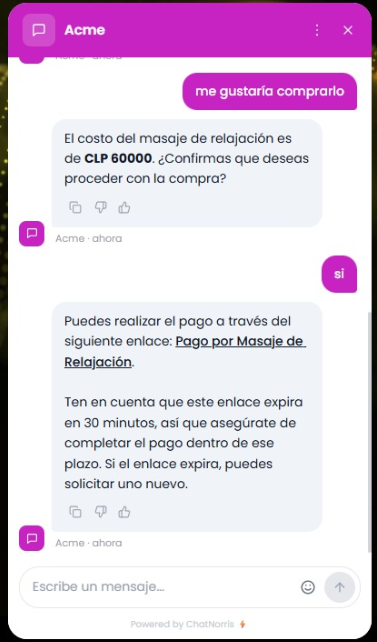
- The visitor asks about a product or service. The agent replies with the configured price — it never invents or calculates an amount, it always reads the exact value you loaded into the catalog.
- The agent asks for an explicit confirmation before generating any link — a clear "yes, I want to buy it," not an ambiguous reply. Creating a checkout is a step with real money attached, so it never fires just because the conversation "sounds like" the visitor agreed.
- The agent hands over the SumUp payment link. That link expires after 30 minutes; if it expires, the visitor can simply ask for a new one.
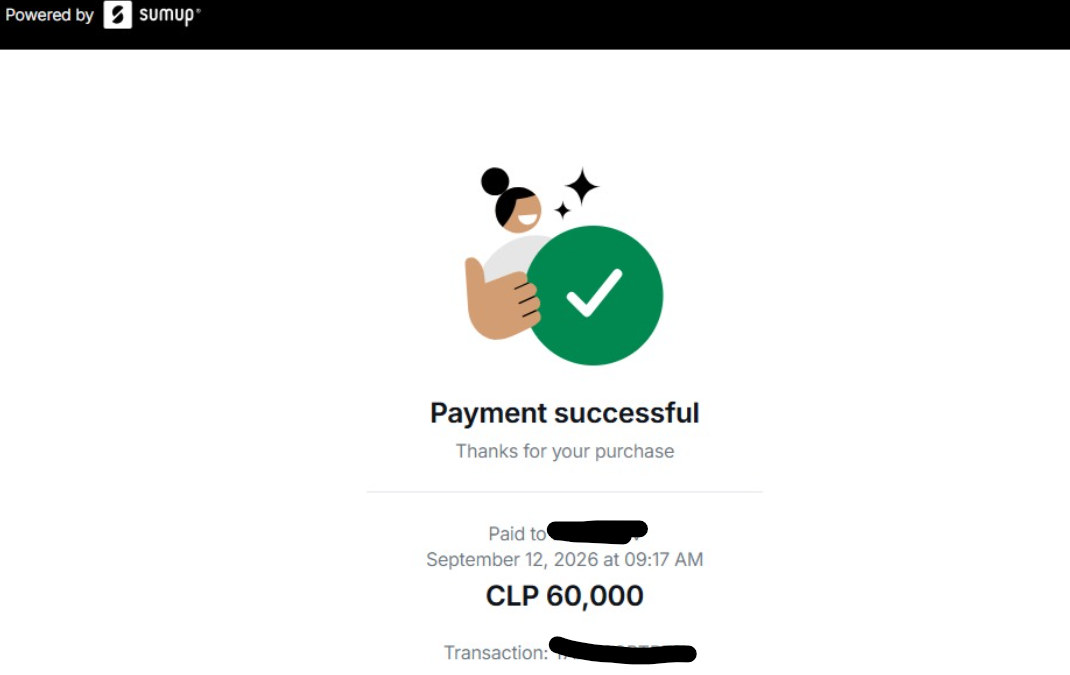
- The visitor pays on SumUp's own page — entirely outside ChatNorris, with SumUp's branding and security.
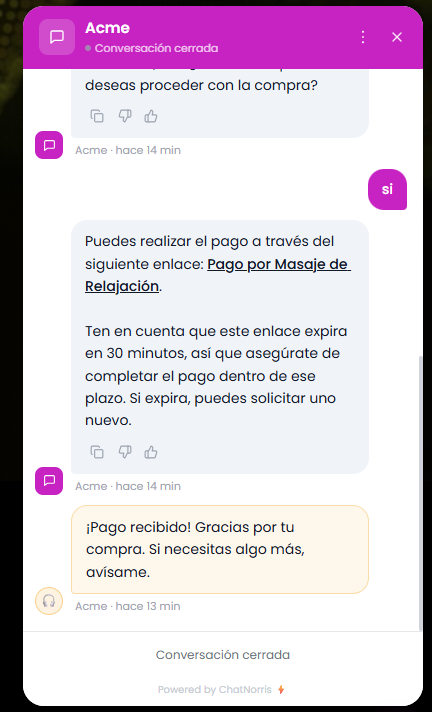
- The agent confirms the payment in the same conversation, as soon as SumUp lets ChatNorris know the charge went through — no one has to refresh anything or ask "did the payment come in yet?"
Why SumUp handles the payment, not ChatNorris
This isn't just a legal disclaimer — it's a deliberate design decision. The payment link your agent delivers is a SumUp Hosted Checkout page: it opens on SumUp's own domain, with SumUp's own interface, and all handling of sensitive card data happens there — never in a form of ours, and never embedded in the chat.
In concrete terms:
- ChatNorris never sees or stores a card number, CVV, or any payment detail. The only thing we keep about a charge is its status (pending, paid, failed) and the amount — never card information.
- The money goes straight into your SumUp account, not to ChatNorris. We're not a payment intermediary: we generate the link, nothing more.
- Security and payment compliance (PCI) are handled entirely by SumUp, which is exactly what its Hosted Checkout page is designed for — keeping that off the merchant's own site or chat.
What you need to turn it on
- An active SumUp account for your business (you can create one directly at sumup.com if you don't have one yet).
- Your SumUp API key and merchant code, which you paste once into your agent's Integrations hub.
- A configured catalog of items your agent can charge for (name, price, currency, optional description) inside the Payment action.
ChatNorris validates the connection against your real SumUp account when you save it, so you know right away whether the API key and merchant code are correct before turning anything on.
Available on the Standard and Premium plans
Unlike some integrations reserved for Premium, the Payment action with SumUp is available starting on the Standard plan. You can check the full breakdown on our pricing page.
Set up your catalog, connect your SumUp account, and deliver payment links without leaving the chat — in minutes, from the Integrations hub.
Start for freeBottom line
Your ChatNorris agent could already handle support and look up orders. Now it can also close the sale — generating a real SumUp payment link the moment the customer says yes, without ChatNorris ever touching a card detail or a cent of the charge. You can browse the rest of our integrations or start for free to set it up on your own agent.