
ManyChat is one of the best-known tools for automating marketing conversations on Instagram, Messenger, and WhatsApp. Its flows can react to keywords, deliver sequences, and turn comments or direct messages into leads.
That approach works well for acquisition, but it is not always the right model for customer service. Answering a question about a return policy, interpreting documentation, or preserving the context of a case requires a trained knowledge agent and a clear path to a person.
If you are looking for a ManyChat alternative for 24/7 support, change the question first. You may not need another flow builder; you may need a different product category.
Marketing automation and AI support are different jobs
| Primary need | Better-fit category |
|---|---|
| Capture leads from comments and DMs | Marketing automation such as ManyChat |
| Answer from website and document content | RAG-based AI agent |
| Run campaigns with many WhatsApp operators | Messaging platform or BSP |
| Help shoppers while they browse | Ecommerce live chat |
Five alternatives by use case
1. ChatNorris — for resolving questions with company knowledge
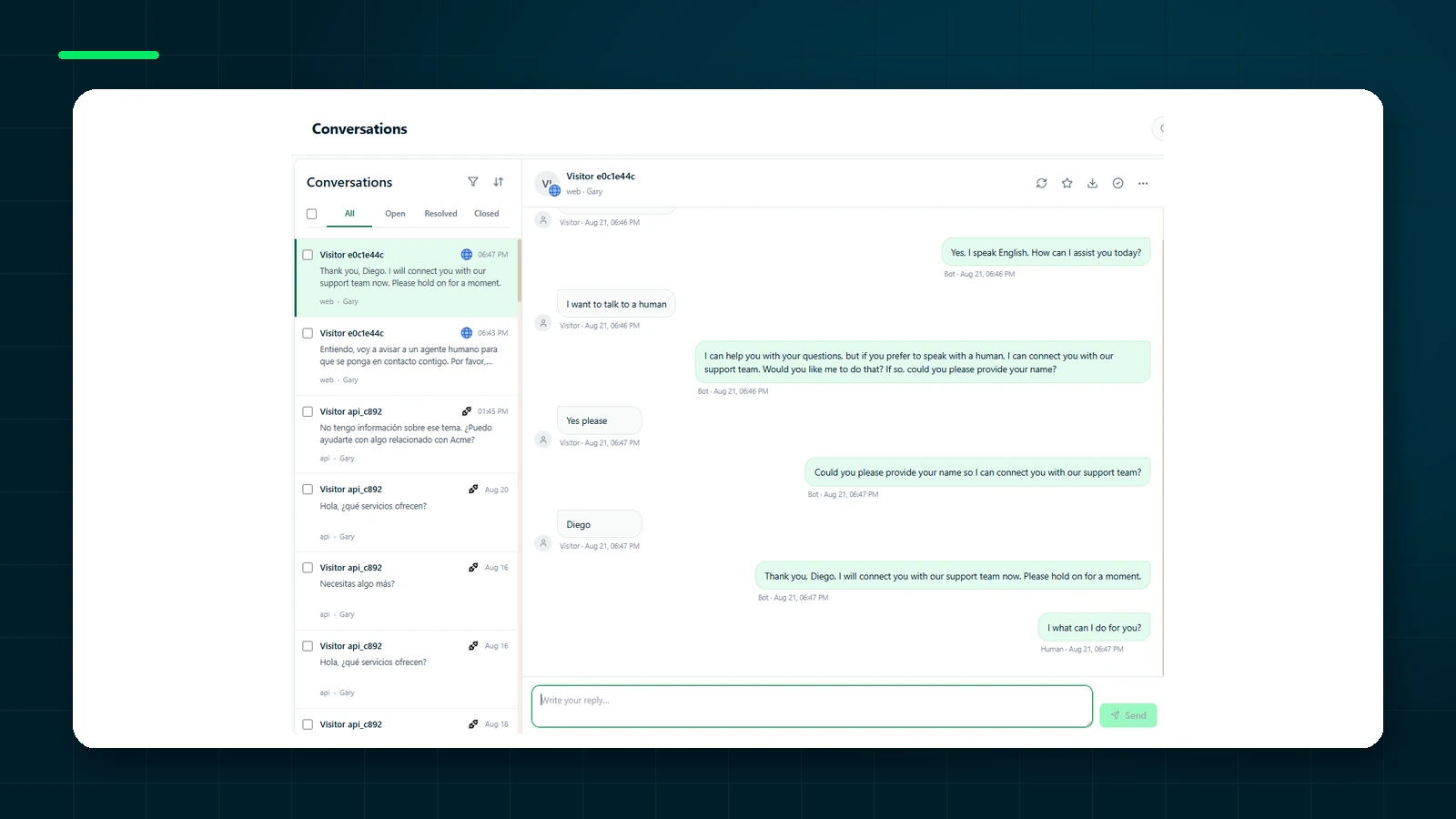
ChatNorris creates an agent from your website, documents, FAQs, and integrations. The same knowledge can serve the web and WhatsApp on Standard; Instagram and Messenger are available on Premium. When a person is needed, the conversation can be handed over with its context.
- Answers grounded in company content
- One agent across web and messaging channels
- Conversation inbox, lead capture, and human handoff
- Does not replace ManyChat campaigns or sequences
- Instagram and Messenger require Premium
Best for: companies that want to automate support and presales questions, not only start conversations.
Train an agent on your content and test its responses before connecting your customer channels.
Get started freeWhy flows work for acquisition but struggle with support
Marketing flows begin with a known intent. A person comments a keyword, requests a resource, or responds to a campaign; the automation knows which message comes next. That structure provides control and measurable conversion steps. It also lets non-technical teams design experiences visually.
Customer support begins differently. A user arrives with a question that was not selected from a menu and may combine several topics in one message. They might need help interpreting a warranty, comparing products, or explaining a problem they have already tried to solve. Building a branch for every possibility makes the flow difficult to maintain and still leaves cases uncovered.
A knowledge-based agent replaces part of that tree with information retrieval and natural language. Rules are still necessary: boundaries, validation steps, and escalation criteria remain important. What changes is that the team maintains content and policies instead of drawing a path for every possible phrase.
When ManyChat is still the better decision
Changing categories is not always necessary. If most value comes from comment triggers, nurture sequences, promotions, and contact segmentation, ManyChat is still solving the right problem. A support agent may answer more effectively, but it will not necessarily convert a social audience more effectively.
ManyChat can also be preferable when marketing needs complete autonomy to change campaigns quickly. Agent platforms require more attention to source quality and answer boundaries. That editorial control is valuable for support but may slow acquisition experiments.
The signal to consider an alternative appears when the team builds complex branches that imitate a knowledge base, when customers regularly write outside the expected options, or when the same answer must be maintained in ManyChat, the website, and a separate support platform.
Design a handoff between marketing and support
You do not have to select only one tool. ManyChat can capture interest and initial information; an agent can answer detailed questions; a person can handle exceptions or complex sales. The challenge is deciding where the transition happens and which system preserves history.
Avoid moving users without explanation to another bot that asks the same questions again. Use a clear signal—such as support intent, an open-ended question, or a request for a person—and pass all context available through the integrations. If technical transfer is not possible, explain the change and ask only for missing information.
Keep metrics separate as well. Marketing will measure contacts, opens, and conversions. Support should monitor accuracy, resolution, escalation, and satisfaction. Forcing both teams to optimize the same metric often creates automation that generates activity without solving the customer's problem.
What content a support agent needs
Before migrating, gather questions that currently end in complex branches or human intervention. Turn repeated answers into clear sources, remove contradictions, and assign owners for updates. Include examples of situations that must be escalated, such as exceptional returns, contract changes, or sensitive data.
An agent does not improve by receiving more pages indiscriminately. It improves when information is precise, well structured, and bounded. Test several versions of the same question and verify that the answer preserves meaning without inventing terms.
2. Chatling — for an agent centered on the widget
Chatling also trains agents on company content and offers visual tools and a broad model selection. It is a sensible alternative when the website remains the primary channel. See ChatNorris vs Chatling for a closer look at channels and integrations.
3. Tidio — for live chat in an online store
Tidio combines human operators, automations, and its Lyro agent. It fits when the gap left by ManyChat is on the website, especially during purchase. Its AI packaging works differently; our Tidio alternatives guide explains the tradeoffs.
4. Wati or Respond.io — for WhatsApp operations at scale
These platforms emphasize templates, campaigns, teams, and messaging volume. They are stronger candidates when you need a complete WhatsApp operation, even if knowledge-based AI is not the center of the product.
5. Chatfuel — for staying with Meta automation
Chatfuel is a more direct alternative when you want to switch vendors without leaving marketing flows. It does not, by itself, solve the move toward knowledge-based customer support.
Verdict
Keep ManyChat if your priority is acquiring and nurturing contacts through social channels. Consider ChatNorris or Chatling when AI must understand company information and resolve open-ended questions. Evaluate Wati or Respond.io when the main challenge is operating WhatsApp at scale.
The tools can also coexist: an automation starts the conversation, and a support agent resolves it. The key is not asking a marketing flow to do the work of a knowledge base.
Frequently asked questions
Does ChatNorris replace every ManyChat feature?
No. ChatNorris prioritizes knowledge agents, customer support, and human handoff. ManyChat is better suited to sequences, comment automation, and acquisition campaigns.
Can I keep ManyChat for Instagram and use another agent on WhatsApp?
Yes, but decide how data will be shared and which team monitors each inbox. The combination makes sense when each channel has a distinct role and customers are not trapped between systems.
Can an AI agent capture leads too?
Yes. It can request contact details during a conversation and store them for follow-up. The difference is that capture often happens after understanding the need rather than through a fixed marketing sequence.