
Tidio has become a familiar choice for stores that need live chat, automations, and straightforward Shopify or WooCommerce setup. Its strength is connecting website visitors with human operators while they browse.
The decision becomes less simple when AI moves from a trial to handling a meaningful share of demand. Lyro has its own conversation allowance, so total cost depends on both the Tidio plan and agent usage. That is not necessarily a drawback, but it does require budgeting with real traffic.
The alternatives below do not try to copy Tidio. Each is better suited to a different scenario.
Identify your priority before switching
- Live chat: if operators drive sales inside the website, Tidio remains a strong option.
- Autonomous resolution: if AI must answer from policies, documents, or catalog data, compare knowledge capabilities.
- Channels: if customers use WhatsApp, determine whether the same agent can serve them or another tool is required.
- Pricing model: compare conversations, resolutions, and credits against monthly volume—not just entry price.
Five Tidio alternatives
1. ChatNorris — for one agent across web and WhatsApp
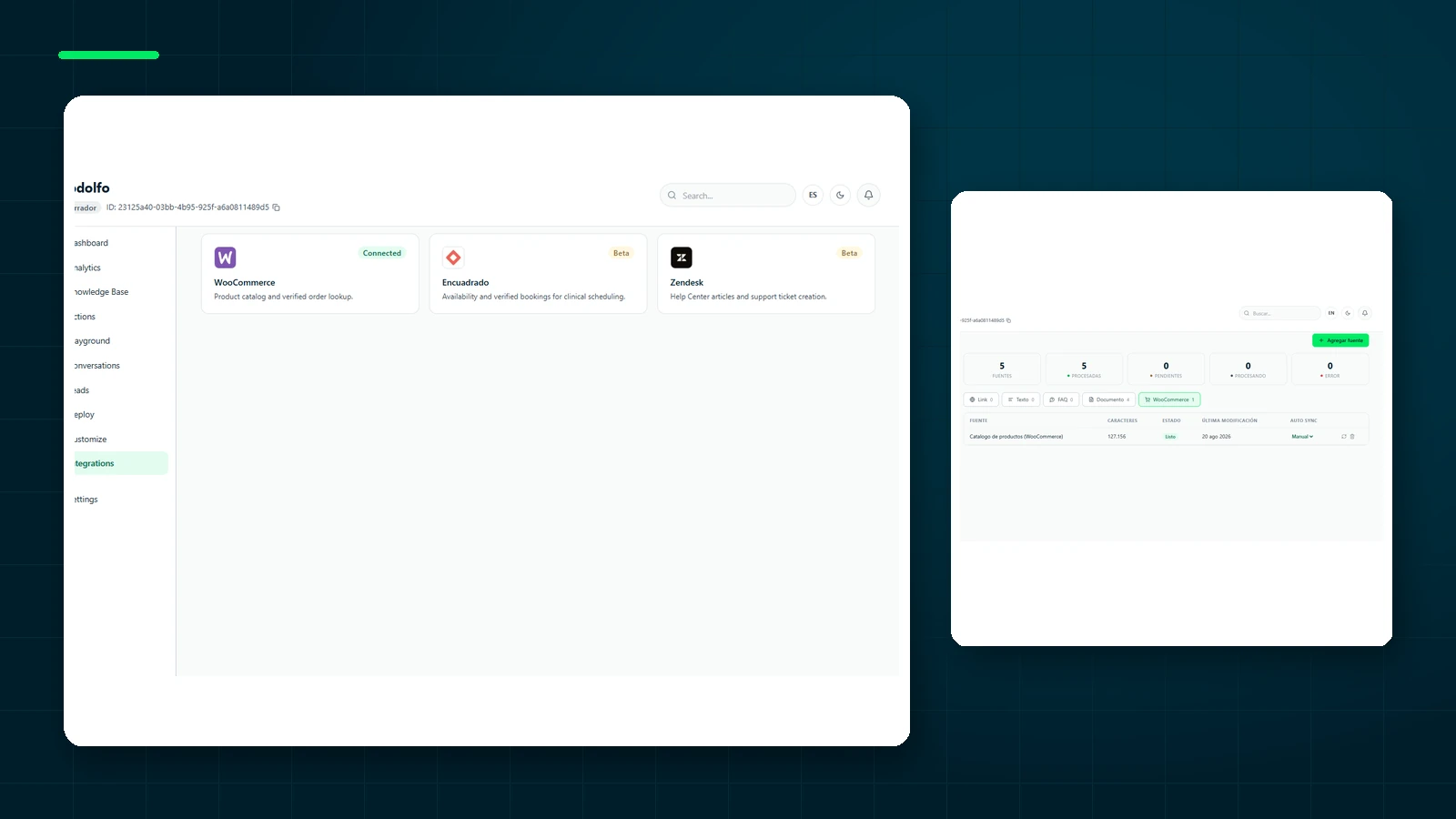
ChatNorris puts AI at the center. The agent learns from websites, documents, FAQs, and connections such as WooCommerce or Zendesk. Plans include a visible credit allowance and enable channels explicitly; WhatsApp is available from Standard.
- AI is part of the plan with a visible credit limit
- One knowledge base for web and WhatsApp
- Human handoff and lead capture
- Tidio has more mature live-chat and ecommerce triggers
- Shorter track record as a WordPress plugin
Best for: businesses that want to resolve questions around the clock with company knowledge and already receive demand through WhatsApp.
Train ChatNorris on your website and evaluate its answers in the playground without using credits.
Get started freeThe difference between answering and resolving
Live chat reduces the distance between a visitor and a person. That is valuable for complex products or purchases where a conversation can unlock a decision. Moving a question from a webpage to an operator, however, does not mean the company has automated it. The team still spends time reading, finding information, and composing the answer.
An AI agent tries to resolve part of that work before handoff. To do it well, the agent needs access to policies, catalog data, documentation, and FAQs—and it must recognize when human intervention is necessary. This is why two tools with similar-looking widgets can produce very different operational outcomes: one improves human work, while the other attempts to remove repetitive work where a person adds little value.
Neither approach is universally better. A store selling high-value products may benefit from proactive human conversations. A service company receiving hundreds of repeated questions may gain more from autonomous resolution. Before migrating, classify a sample of conversations and estimate what percentage truly requires a person.
Comparing Lyro conversations with agent credits
The billed unit changes how a budget grows. An AI-conversation allowance is intuitive when each conversation represents a complete case. A credit system lets teams choose models with different consumption, but requires an estimate of how many answers each case needs. Neither unit is automatically cheaper.
Use your own data. Take one month of conversations, identify those AI could resolve, and calculate the number of turns in each. Add room for peaks and longer cases. Then compare that scenario with Lyro's current tiers and the alternative agent's credit allowance. This estimate is more useful than a generic example on a pricing page.
Consider what happens at the limit as well. Some platforms offer overages or additional capacity; others pause AI until the next period. A hard limit prevents billing surprises, but requires alerts and a fallback so customers are not left without service.
Migrate without interrupting support
Do not remove the current widget on the same day you create a new agent. First export or document FAQs, saved replies, escalation rules, and welcome messages. Train the alternative and test at least the twenty most common contact reasons.
During a controlled stage, publish the new agent on lower-risk pages or during limited hours. Review answers, cited sources, and escalations. Once behavior is stable, expand coverage and teach the team how to take over a case. The goal is not to reproduce every Tidio automation. Keep the ones that create value and remove those that exist only because they were configured years ago.
If you use WooCommerce or Shopify, validate orders, catalog content, and policies separately. An integration that exposes order data requires identity controls that are different from a public source explaining shipping times.
2. Chatling — for model choice and website experiences
Chatling offers agents trained on company content, visual building tools, and a broad selection of models. It is a good alternative when the web experience is the priority. Read ChatNorris vs Chatling for a closer multichannel comparison.
3. Crisp — for a straightforward shared inbox
Crisp fits when people will continue to handle most conversations and need chat and email in one place. AI supports the inbox rather than defining the product. See our guide to Crisp alternatives.
4. Intercom Fin — for advanced support processes and analytics
Intercom combines Fin with help-center content, routing, reporting, and a broad service suite. Costs may include seats and AI usage, but the platform offers capabilities suited to teams with more complex processes and metrics. Read ChatNorris vs Intercom Fin.
5. Gorgias — for ecommerce-centered support operations
Gorgias makes sense when a team must manage orders, returns, and store tickets from a specialized help desk. It is an alternative to Tidio because of its operational focus, not because it is the simplest standalone AI agent.
Verdict
- Choose Tidio when live chat and in-purchase engagement matter most.
- Consider ChatNorris or Chatling when you need an agent trained on your content.
- Evaluate Crisp for a cost-conscious shared inbox.
- Move toward Intercom or Gorgias when the support operation justifies a specialized suite.
The useful comparison is not which tool has the longest feature list. It is what it costs to resolve a complete conversation in the channels your customers already use.
Frequently asked questions
Do I have to leave Tidio to use another AI agent?
Not necessarily. You can keep Tidio for human chat and use another agent on a different section or channel. The cost of operating two inboxes and two histories determines whether that setup is sustainable.
Which alternative is best for WooCommerce?
It depends on the goal. Tidio is strong for engagement inside the store; Gorgias goes deeper into support operations; ChatNorris prioritizes knowledge and continuity with WhatsApp. Test the specific action you need, not just whether a WooCommerce logo appears on the integration page.
How do I know whether AI is working?
Measure useful answers, correct escalation, repeated questions, and satisfaction—not only “closed” conversations. An incorrect resolution can reduce tickets while making the customer experience worse.