The word omnichannel describes very different products. One platform may bring WhatsApp, Instagram, and email into an inbox for human agents. Another may train one AI agent and use it across multiple channels. Both connect conversations, but they solve different problems.
This guide compares five well-known platforms by their primary operating model. The useful question is not which vendor lists the most channels. It is who will do most of the work: your team or AI.
Two approaches to omnichannel support
Inbox first: centralize messages, assign conversations, track response times, and run campaigns. This is the broad approach taken by Respond.io, Intercom, Crisp, and—partly—Tidio.
Agent first: use the same knowledge base, instructions, and context to answer across touchpoints, then involve a person when needed. This is the approach taken by ChatNorris and other AI-agent platforms.
Five platforms to consider
1. Intercom — for support inside digital products
Intercom combines messaging, help-center content, routing, analytics, and the Fin agent. It is a powerful option for software companies with established support teams, especially when conversations happen inside the product. Its breadth also brings the setup and cost structure of a full suite. See ChatNorris vs Intercom Fin.
2. Respond.io — for B2C messaging at scale
Respond.io brings together many channels, teams, automations, and campaigns. It stands out when several people handle a large conversation volume and the business depends on templates or outbound messaging. It is primarily an operations platform rather than a knowledge agent.
3. Tidio — for ecommerce live chat
Tidio combines a website widget, human operators, automations, and its Lyro agent. It fits stores that want to help visitors during purchase. Its center of gravity remains the website experience; see Tidio alternatives if AI resolution matters more.
4. Crisp — for small teams sharing an inbox
Crisp offers an accessible way to combine chat, email, and human support. It works well when a few people resolve most conversations and need coordination. If a knowledge-based agent should take the lead, read our guide to Crisp alternatives.
5. ChatNorris — for one agent across web and messaging
ChatNorris trains an agent on websites, documents, FAQs, and integrations, then uses that knowledge on the web and the channels included in each plan. WhatsApp is available from Standard; Instagram and Messenger are on Premium. Conversations can be handed to a person within the same platform.
- One knowledge base across channels
- Official WhatsApp onboarding through Meta
- Included AI credits with visible limits
- Does not replace a high-volume B2C inbox
- Fewer campaign channels and automations than Respond.io
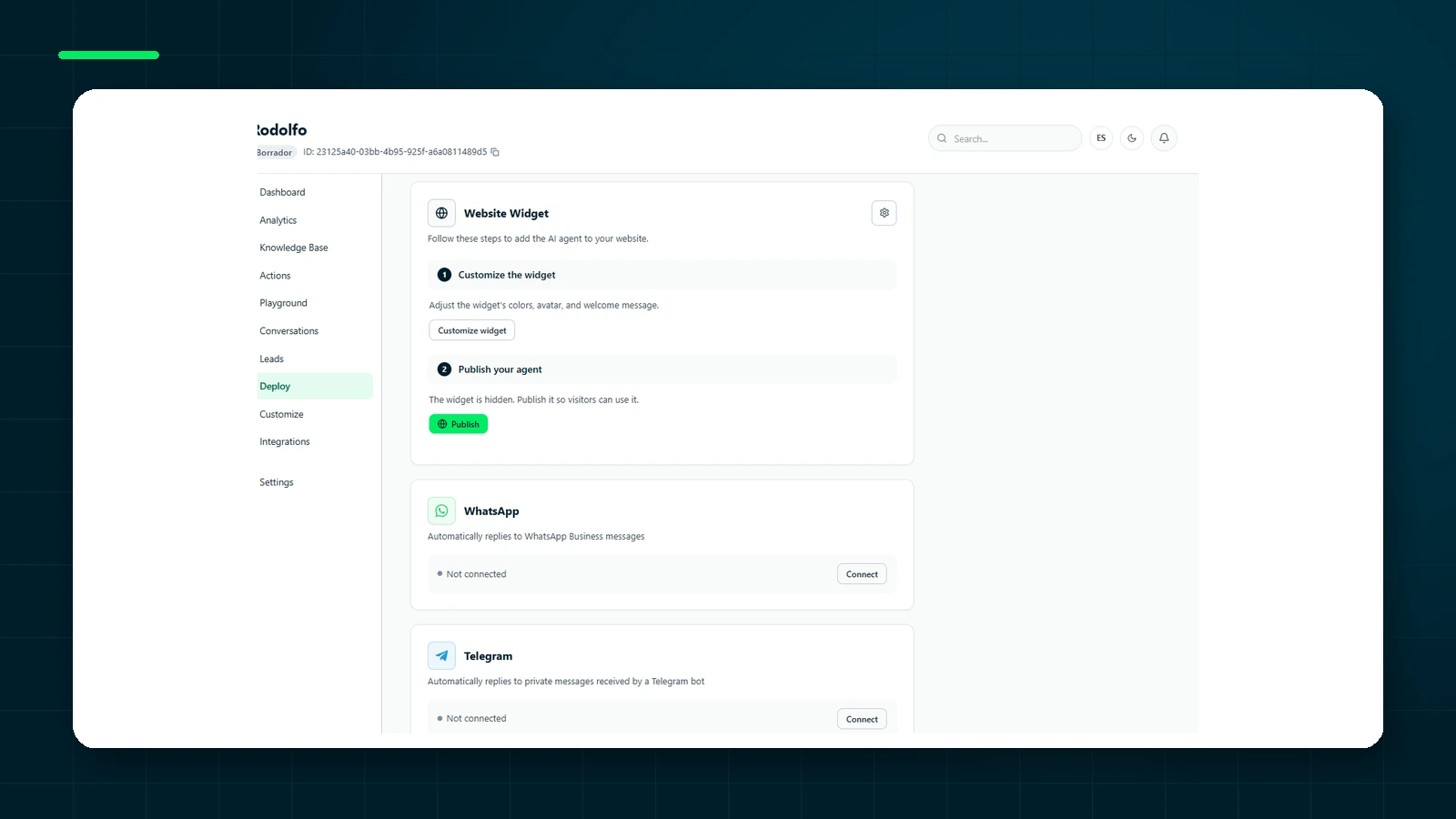
Train once, publish on the web, and connect only the channels your operation actually needs.
Get started freeWhat an omnichannel experience actually means
Being present in several channels does not guarantee an omnichannel experience. A company may offer a website widget, a WhatsApp number, and an Instagram account while forcing customers to repeat their name, problem, and previous troubleshooting whenever they switch channels. That is a multichannel operation: several touchpoints exist, but they work independently.
The experience becomes omnichannel when there is continuity. The team can recognize the customer, understand what happened before, and follow a consistent service policy. For an AI agent, continuity starts with the same knowledge base, instructions, and escalation rules. Matching a person's identity across every platform is not always possible, but teams can still avoid maintaining a separately trained bot for each channel.
Coverage and continuity are also different. One platform may connect ten networks without preserving context. Another may support only web and WhatsApp but use the same knowledge and handoff workflow in both. The first offers wider reach; the second may deliver greater consistency. The right choice depends on which channels generate meaningful demand.
How to evaluate a platform beyond its channel list
Knowledge and maintenance
Ask how the information used by AI stays current. When a price, policy, or webpage changes, the agent should be able to incorporate the new version without rebuilding the entire configuration. It also matters whether the platform can combine website content with documents, FAQs, and external systems. Initial coverage looks impressive in a demo; ease of maintenance determines whether the project still works six months later.
Conversation history and human handoff
An agent should not hide its limitations. When a question requires a commercial exception, private data, or human judgment, the platform should escalate with the available context. Check who receives the conversation, how the team is notified, and whether the customer understands that a person has taken over. Some businesses do not need an advanced inbox, but no customer should reach a dead end.
Governance and permissions
As the team grows, operational questions appear: who can change instructions, connect a channel, read conversations, or export data? Enterprise suites usually offer deeper roles and auditing. Agent platforms tend to simplify deployment. Do not pay for controls you will never use, but do not ignore them if several departments will operate the service.
Costs that scale in different ways
Pricing models often combine seats, contacts, conversations, resolutions, channels, or AI credits. Compare them using three scenarios: a normal month, a demand spike, and a month in which automation works better than expected. The cheapest plan on a pricing page can become expensive after adding operators or usage. A plan with a hard allowance can instead pause service if nobody monitors it. Predictability comes from understanding the billed unit.
Three decision scenarios
A SaaS company with eight support agents is likely to value routing, SLAs, reporting, and conversations inside the product. Intercom is a more natural reference point than a tool focused primarily on the agent.
A consumer brand running campaigns and handling thousands of messages needs templates, segmentation, automation, and coordination across many operators. Respond.io is closer to that job than ChatNorris or Tidio.
A small business receiving recurring questions on web and WhatsApp may not need a full suite. If the goal is to answer from company information and escalate exceptional cases, ChatNorris offers a more direct path and a cost structure that is easier to bound.
How to choose
| If your priority is… | Start with |
|---|---|
| Complex support inside a SaaS product | Intercom |
| High-volume B2C messaging and campaigns | Respond.io |
| Live chat for an online store | Tidio |
| An affordable inbox for a small team | Crisp |
| AI resolution across web and WhatsApp | ChatNorris |
Choose an omnichannel inbox when people will handle most conversations. Choose a multichannel agent when AI should respond first using company knowledge. That distinction helps you avoid paying for an operation you do not need—or outgrowing a tool that was never built for your volume.
Frequently asked questions
Does an omnichannel platform replace a CRM?
Not necessarily. The platform manages conversations; a CRM manages commercial relationships, opportunities, and sales processes. Some suites combine the layers or integrate with a CRM, but teams should define which system owns customer data.
Do I need to support every channel?
No. Start with the two or three channels that generate demand and that your team can operate well. Adding a channel without owners, hours, and escalation rules often makes the customer experience worse rather than better.
Can AI preserve exactly the same context across channels?
It depends on user identification and each channel's capabilities. The agent's knowledge, tone, and decision logic should remain consistent. Identity and history require a conversation architecture that respects the privacy rules and technical limits of every platform.